latest news
View more
Introduction to spring cone crusher equipment
Time:2026-04-07
Author:
Spring Cone Crusher
A spring cone crusher is an advanced, high-power, large-crushing-ratio, and high-production-rate crushing device designed for medium and fine crushing operations. It is suitable for crushing medium-hard to hard ores and rocks, such as iron ore, copper ore, granite, quartz, etc. Below is a detailed introduction to spring cone crushers:
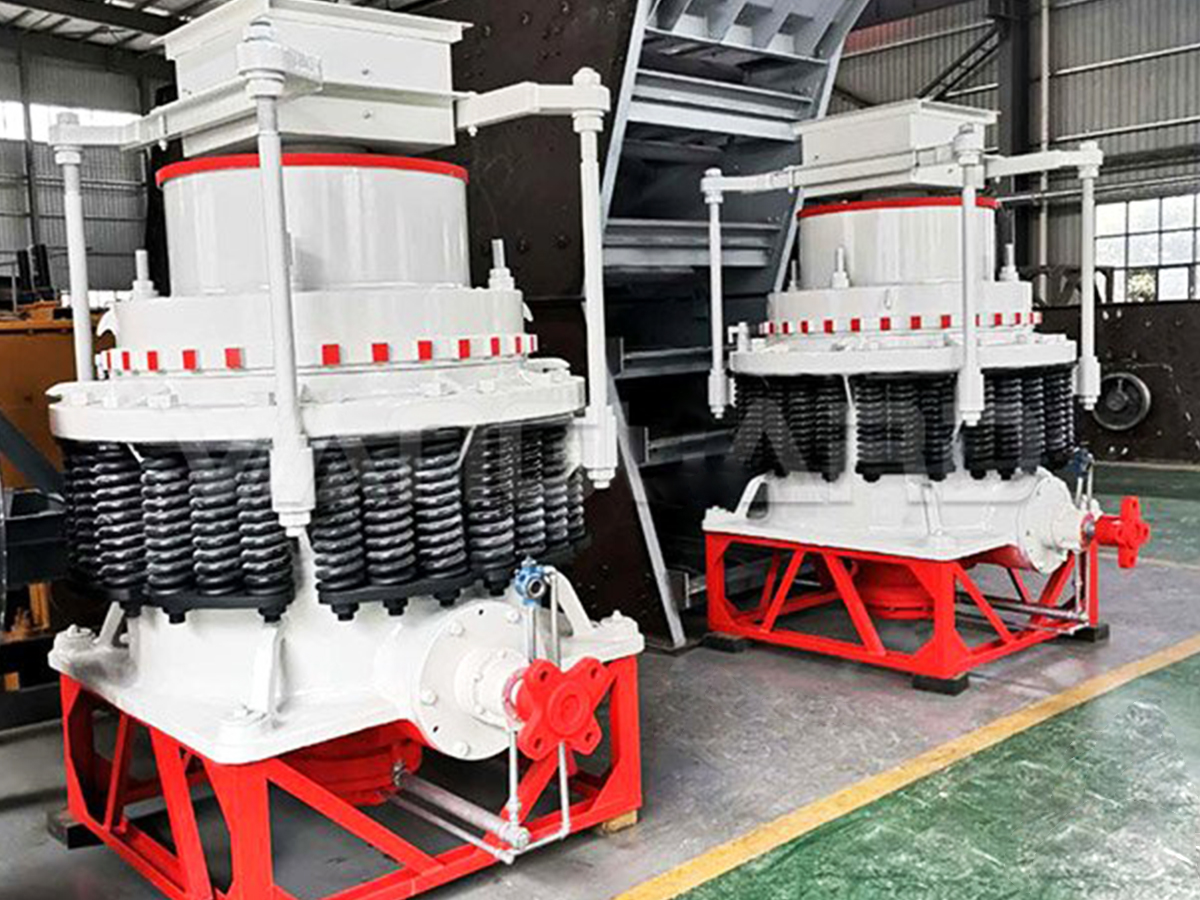
I. Structural Composition
A spring cone crusher mainly consists of a frame, transmission system, eccentric sleeve, moving cone, fixed cone, and other components. Additionally, it includes auxiliary parts such as spring safety devices, adjustment devices, lubrication systems, and hydraulic systems.
- Frame: Constructed from cast steel with reinforced ribs at heavy-load sections to enhance stability and durability.
- Transmission System: Includes an electric motor, fluid coupling, transmission shaft, and large and small bevel gears to drive the rotation of the eccentric sleeve.
- Eccentric Sleeve: Rotates to drive the moving cone in a gyratory motion, facilitating the crushing of materials.
- Moving Cone and Fixed Cone: Form the crushing chamber where materials are crushed by compression, bending, and shearing forces between the two cones.
- Spring Safety Device: When uncrushable materials enter, the springs compress, increasing the discharge opening to expel the foreign objects and protecting the equipment.
- Adjustment Device: Used to adjust the size of the discharge opening to control the particle size of the output material.
- Lubrication System: Employs dry oil or water sealing to isolate dust, ensuring clean lubricating oil and extending the service life of sliding bearings and thrust ball bearings.
- Hydraulic System: Used for adjusting the discharge opening size and clearing the crushing chamber of obstructions.
II. Working Principle
The electric motor drives the eccentric sleeve through the fluid coupling, small bevel gear, and large bevel gear at the bottom of the eccentric sleeve, causing it to rotate. The rotation of the eccentric sleeve drives the moving cone in a gyratory motion, bringing it alternately close to and away from the fixed cone. Materials in the crushing chamber are crushed by compression, bending, and shearing forces. When uncrushable materials enter, the springs compress, increasing the discharge opening to expel the foreign objects and protecting the equipment from damage.
III. Product Features
- Large Crushing Ratio and High Production Rate: Spring cone crushers offer a large crushing ratio and high production rate, meeting the demands of large-scale crushing operations.
- Uniform Product Particle Size: With both the moving and fixed cones oriented upright, there is a parallel zone with equal clearance near the discharge opening of the crushing chamber, ensuring uniform product particle size.
- Laminated Crushing Principle: Adopts laminated crushing to reduce the production of needle-like materials and increase the proportion of cubic particles in the product.
- Overload Protection: Equipped with spring safety devices to protect the equipment from damage when uncrushable materials enter.
- Reliable Structure: The main shaft statically supports the crushing force, enabling the structure to withstand significant crushing forces and making it suitable for fine and ultra-fine crushing.
- Easy Maintenance: The equipment has a simple structure, making it easy to disassemble and repair, reducing downtime for maintenance.
IV. Application Range
Spring cone crushers are widely used in the metallurgical, construction, road-building, chemical, and phosphate industries. They are suitable for crushing hard and medium-hard ores and rocks, such as iron ore, copper ore, limestone, quartz, granite, basalt, and diabase.
V. Technical Parameters (Example: PYB1200 Model)
- Moving Cone Diameter: 1200 mm
- Feed Opening Size: 170 mm
- Maximum Feed Size: 145 mm
- Discharge Opening Adjustment Range: 20-50 mm
- Processing Capacity: 110-168 tons/hour
- Motor Power: 110 kW
- Eccentric Shaft Speed: 300 rpm
- Machine Weight: Approximately 24.7 tons
- Overall Dimensions: 2790 mm × 1878 mm × 2844 mm (or 2810 mm × 2300 mm × 2780 mm)
Equipment Knowledge
View more
2026-01-14
2026-01-14
Best Sellers
View more products